
Faced with high temperatures and dry conditions expected in the coming weeks, local authorities are taking early action by implementing initial water restriction measures in four départements in western France.
In the south-west France départements of Charente, Charente-Maritime, and Deux-Sèvres, the Aume-Couture basin - which spans all three départements - is under alert.
Its neighbouring basin, the Auge basin in Charente, is also affected by these measures.
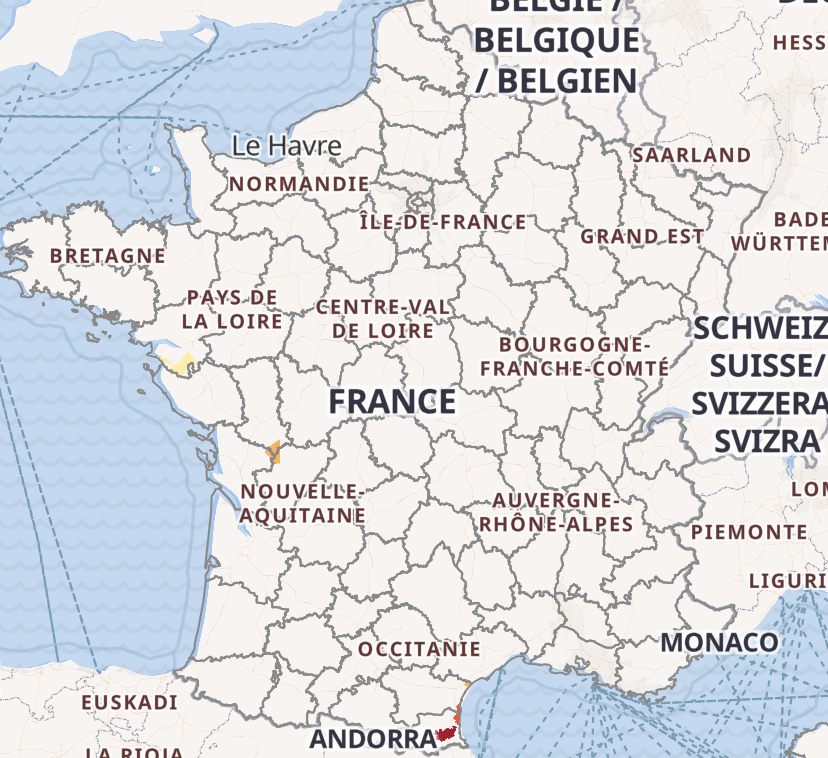 Map from the government website VigiEau that shows the départements on water restrictions. (Credit: VigiEau.gouv.fr)
The water restrictions are on the lowest level, mainly affecting farmers but also covering daytime watering of gardens, while washing a vehicle is now prohibited.
Since April 16th, irrigation of farmland has been banned on Wednesdays, Saturdays, and Sundays.
Find further details of the restrictions, and whether they affect your area, here.
Farmers are worried this will affect their work. "In Charente, if there is no rain, it will be a catastrophe. The amount of straw per hectare will be halved. The grain intake will be divided by three," told worker François Michaud to French media France 2.
Meanwhile, in the département of the Loire-Atlantique (coast of western France) has been placed under 'caution' - this means that no measures or restrictions have yet been put in place, but the Préfet is urging residents to take steps to limit water use in the coming weeks and to prepare for summer.
The département also reminds people that activities such as planting, façade cleaning, and filling swimming pools should preferably be carried out during periods of high water levels.
Climate change
In April, above-average seasonal temperatures have warmed the ground. The water it contained was released into the atmosphere, and the remaining water was consumed by the rapidly growing vegetation. The soil thus became parched while the groundwater was replenished.
"Both things are typical. The more intense rainfall during the winter and the now faster evaporation during the spring. And this is a trend we should expect in the coming decades, one that will intensify," said Jan Polcher, research director at the CNRS (French National Centre for Scientific Research), to French media France 2.
Faced with this situation, the prefects call on everyone to make "responsible use of water resources".
READ MORE: EXPLAINED: How to check water restrictions in your area of France
Over the weekend the first forest fire of the year was recorded, in northern France.
Comments